If you've shopped for a cat house in the last year, you've probably noticed two shapes competing for your money: the classic dome tent, which looks like a pop-up beach shelter, and the A-frame tent, which looks more like a tiny house with a pointed roof and straight walls. This isn't just a style choice. The shape changes how the thing holds up, how your cat uses it, and whether it survives more than one nap season.
The Dome Tent's Structural Problem
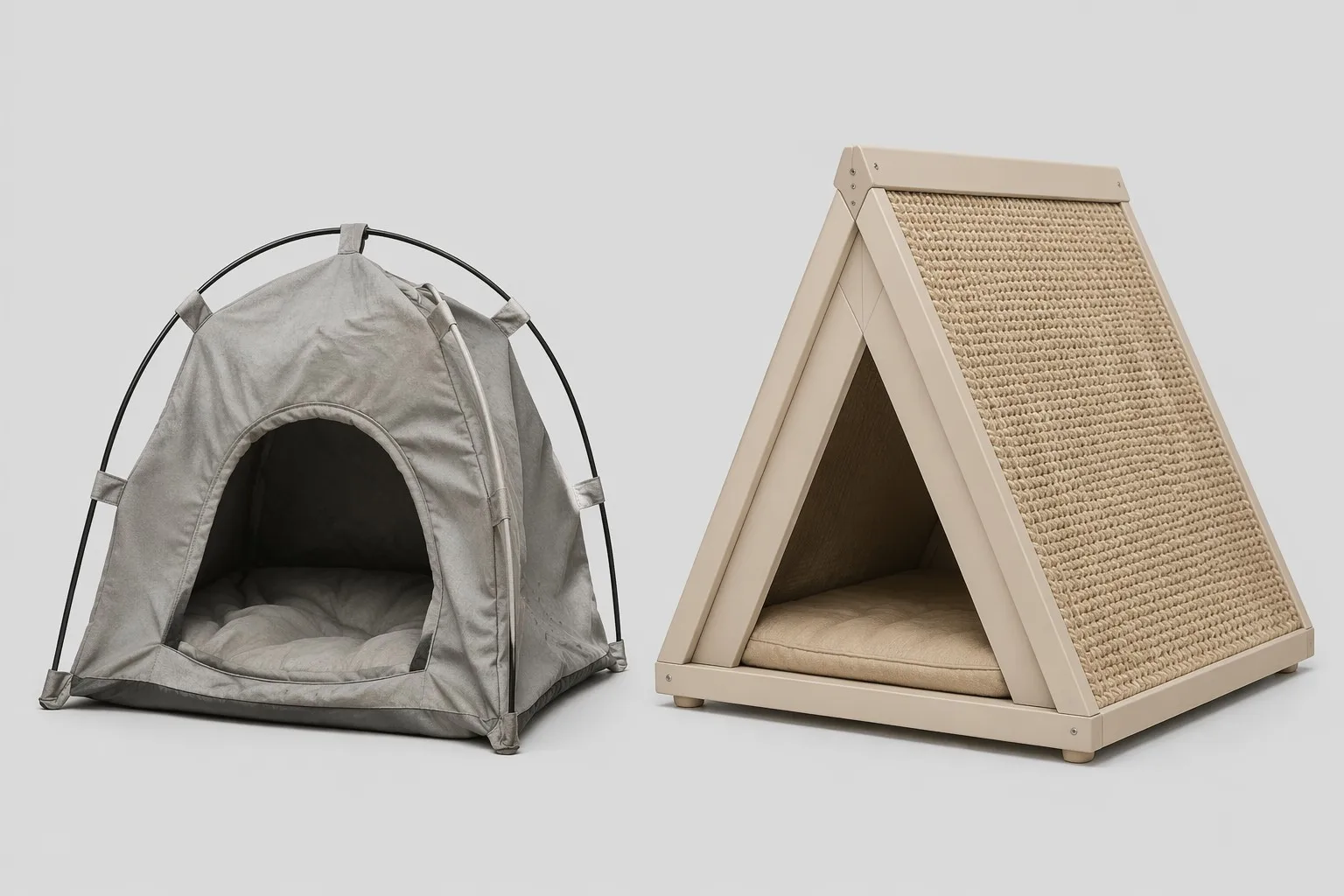
Pop-up dome tents rely on bent wire or fiberglass poles threaded through fabric sleeves. That's fine for a beach umbrella you use twice a year. It's a different story for something a 10-pound animal jumps on daily.
Over time, the poles bow and the fabric sags. Give it a few months and the whole thing starts to look like a deflated balloon. Cats like high ground, so if yours tries to sit on top of the dome (a lot of them do), the structure usually can't take that weight without caving in eventually.
Why the A-Frame Holds Its Shape
An A-frame tent skips the pole-and-fabric approach. It's built more like a tiny house: two angled side panels meeting at a ridge, usually over a rigid or semi-rigid frame. That triangle shape is more stable than a curved dome, for the same reason actual houses have pitched roofs instead of round ones.
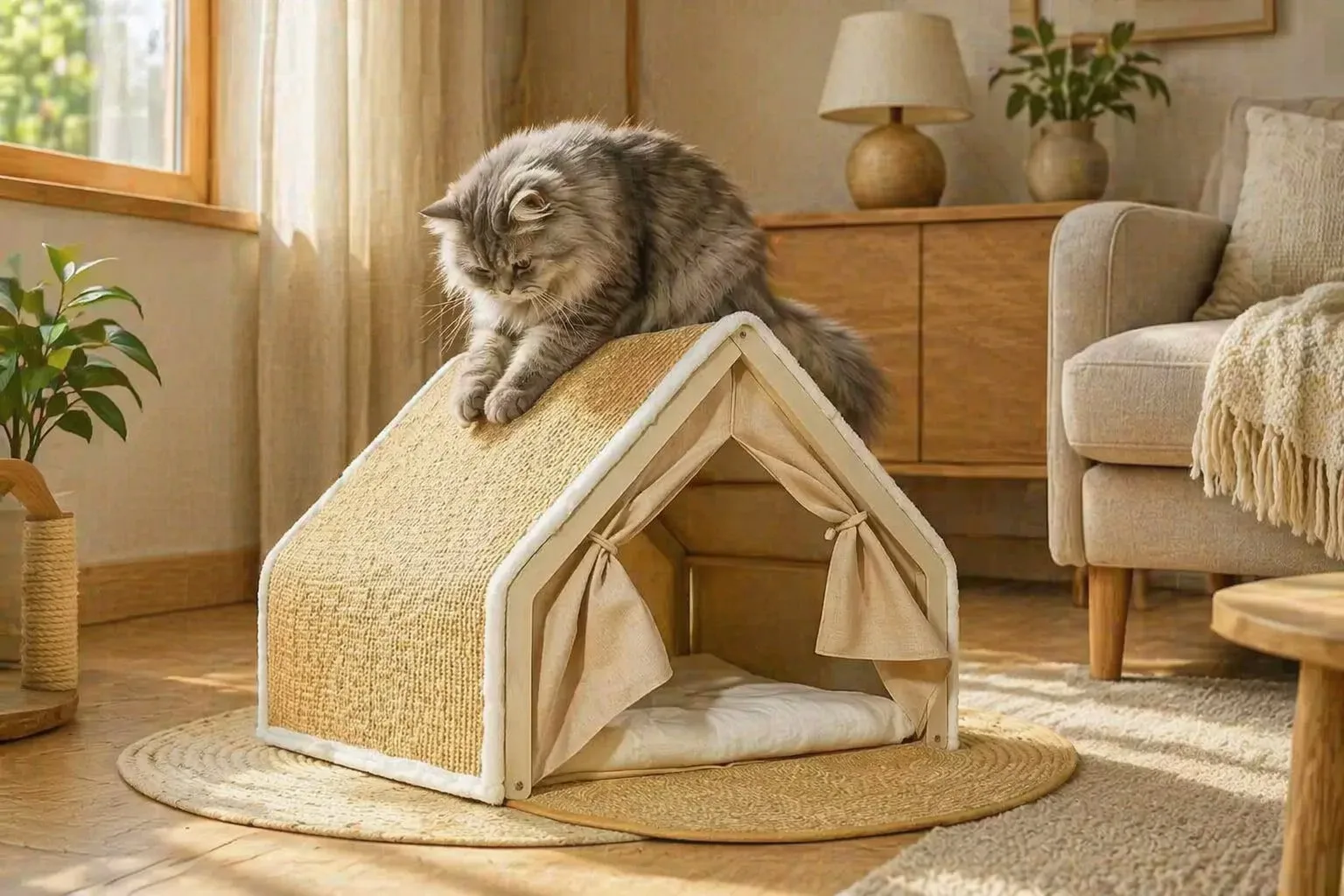
The other advantage is that the roof panel doubles as a scratching surface. Instead of just being a shelter, a sloped sisal roof gives your cat an angled surface to scratch, something a flat floor pad can't offer. You get two functions in the footprint of one object.
Scratching Behavior: Why the Angle Matters
Cats scratch to mark territory and to shed the outer sheath of their claws. Flat floor scratchers work, but a lot of cats actually prefer scratching at an angle or vertically. It lets them get a full-body stretch while they do it.
A dome tent doesn't give you that option. The fabric is soft and rounded, which is comfortable for lounging but not built for scratching. If a cat does claw at dome fabric, it tends to tear rather than hold up. An A-frame's angled sisal roof is scratch-ready by design, so the material matches what your cat's claws are actually built to do.
What You Actually Get With an A-Frame
The Sisal-Roof Cat Tent pairs a sisal-board roof with a soft linen interior, so the scratching surface stays on the outside and the resting spot stays soft. Tie-back curtains let you leave it open during the day or close it up when your cat wants privacy, which they will ask for eventually if you've lived with a cat for any length of time.
Because it's an A-frame instead of a dome, it also holds its shape when a cat jumps directly on top, which is exactly the kind of daily abuse a fabric dome tends to lose to.
Picking Between the Two
If your cat is a lounger who never scratches furniture and just wants a soft place to disappear, a dome tent might work fine for a while. But if you're dealing with claw marks on the couch, or you just want something still standing in six months, the A-frame shape solves the durability problem and the scratching problem in one piece of furniture. We go into more depth on hideout placement in the case for minimalist cat furniture, if you want to think through the room-level picture too.
FAQ
Will my cat actually use the roof to scratch, or just the floor?
It depends on the cat, but many gravitate to angled or raised scratching surfaces because it lets them stretch their whole body while they claw. Placing the tent somewhere your cat already likes to hang out increases the odds they'll use the roof.
Does the A-frame shape take up more floor space than a dome?
Not usually. Both shapes have a similar footprint. The A-frame just uses vertical space more efficiently since the roof itself is functional instead of purely decorative.
Can I still get privacy with an A-frame if it looks more open than a dome?
Yes. Most A-frame tents, including this one, use tie-back curtains on the front opening, so you can close it fully for privacy or leave it open when your cat wants to watch the room.